Go back to listing foods

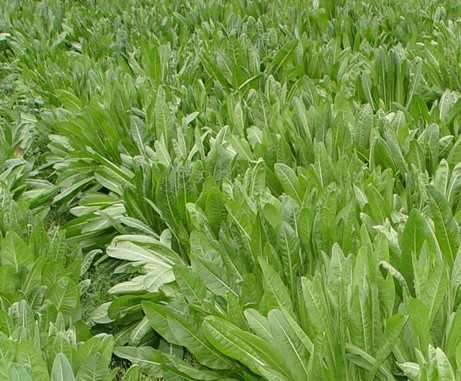
菊苣


Name (CN) 菊苣 (Jú jù)
Synonyms (CN) 蓝菊
Name (EN) Cichorii Herba Cichorii Radix, Herba Cichorii
Scientific name(s) Cichorii Radix, Herba Cichorii, Herba Cichorii Intybi
Used section Dried above-ground parts or roots
Taste Bitter、Salty
Channel Tropism Induce in the liver, gall bladder and stomach meridians.
Cold/Hot properties Cold
Group Plant [Vegetables And Products]

Origin The dried above-ground parts or roots of Cichorium glandulosum Boiss. et Huet or Chicory Cichorium intybus L., family Asteraceae.
Function and treatment Clearing the liver and gallbladder, tonifying the stomach and eliminating food, diuresis and swelling. Used for damp-heat jaundice, stomach pain with little food and edema with little urination.
Origin and best harvesting period Chicory is a Uyghur customary medicine. It is distributed in Beijing, Hebei, Heilongjiang, Liaoning, Shanxi, Shaanxi, Xinjiang and Jiangxi. Among them, chicory root polysaccharide from Hebei has the highest OH scavenging rate and the strongest OH scavenging ability. In northern areas, chicory is harvested in late October and early November, when it has grown for 100-120 d and has formed full fleshy roots, on a rain-free day and before frost. When harvesting, use a shovel or a deep plough to dig up the whole fleshy root with the seedlings, taking care not to injure the roots and not to leave the broken roots in the soil. The dug up chicory seedlings with their roots are placed neatly in the field to dry for 2 to 3 d. Remove the root plants with shoots, trim the root plants, remove the old yellow leaves, leave 3 to 5 cm of leaf stalks at the base of the leaves and cut off the rest.

Related compounds


No. Name(s)
COMP-001398 3,4-di-o-caffeoylquinic acid; 3,4-dicaffeoylquinic acid
COMP-001427 3,5-dicaffeoylquinic acid; isochlorogenic acid a
COMP-001437 5'-o-caffeoylquinic acid; 5-o-caffeoylquinic acid; neochlorogenic acid; 5-caffeoylquinic acid
COMP-001470 3,4-dihydroxy-benzoic acid; protocatechuic acid; 3,4-dihydroxybenzoic acid
COMP-001484 d-mannitol; mannitol
COMP-001521 4-o-caffeoylquinic acid; cryptochlorogenic acid; 4-caffeoylquinic acid
COMP-001563 aesculin; esculin
COMP-001566 isochlorogenic acid
COMP-001579 luteolin 7-glucoside; cinaroside; galuteolin; luteolin-7-glucoside; luteoloside; luteolin 7-o-glucoside; luteolin-7-o-glucoside
COMP-001581 astragalin; kaempferol 3-o-glucoside; kaempferol-3-o-glucoside
COMP-001585 luteolin 7-glucuronide; luteolin 7-o-glucuronide
COMP-001773 l-ascorbic acid
COMP-001775 1,2-benzenediol; catechol; benzene-1,2-diol
COMP-001777 succinic acid
COMP-001781 hyperin; hyperoside; quercetin-3-galactoside; quercetin-3-o-galactoside; quercetin 3-o-galactoside; quercetin 3-galactoside
COMP-001800 citric acid
COMP-001810 kaempferol 7-neohesperidoside; kaempferol-7-o-neohesperidoside
COMP-001841 quinic acid; quinate; (-)-quinic acid
COMP-001844 tartaric acid
COMP-001896 esculetin; aesculetin
COMP-002078 d-aspartate; d-aspartic acid
COMP-002085 apigetrin; apigenin-7-o-glucoside; apigenin 7-glucoside; apigenin 7-o-glucoside
COMP-002105 polygalacturonic acid; pectins; d-galacturonan; pectic acid
COMP-002151 rethinol; retinol; vitamin a
COMP-002284 umbelliferone; 7-hydroxycoumarin; umbelliferon; 7-hydroxycumarin
Displaying 75 - 100 of 247.
Page 4 of 10.

Macro-nutrients


Area N/A
Edible fraction N/A
Energy 17 (Kcal)
Moisture N/A
Protein 1.3 (g)
Fat 0.2 (g)
Fiber 0.9 (g)
Carbohydrates 3.4 (g)
Retinol equivalent 93.8 (µg)
Thiamine 0.08 (mg)
Riboflavin 0.08 (mg)
Niacin 0.4 (mg)
Vitamin E 0 (mg)
Vitamin A 205 (µg)
Vitamin C 7 (mg)
Carotene 1.4 (µg)
Sodium 22 (mg)
Calcium 52(mg)
Iron 0.8 (mg)
Ascorbic acid N/A
Cholesterol 0 (mg)
Magnesium 15 (mg)
Zinc 0.79 (mg)
Copper 0.1 (mg)
Selenium 0 (µg)
Phosphorus 28 (mg)
Potassium 314 (mg)
Manganese 0.42 (mg)