(-)-isopulegol
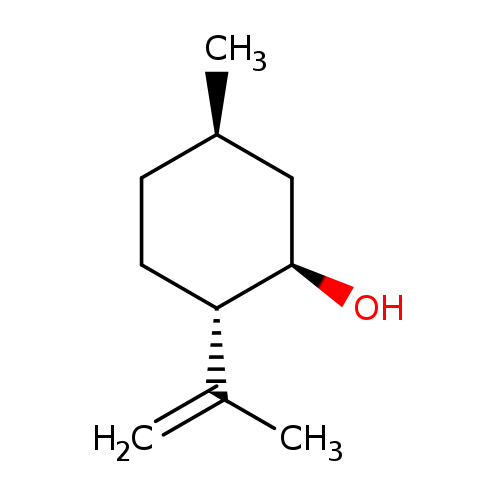
| Name(s) | (-)-isopulegol |
|---|---|
| Scientific name(s) | isopulegol; l-isopulegol; (-)-l-isopulegol; cyclohexanol, 5-methyl-2-(1-methylethenyl)-, (1r,2s,5r)-; unii-3th92o3bxn; 50373-36-9 |
| Formula | C10H18O |
| Molecular mass | 154.25 |
| IUPAC name | (1R,2S,5R)-5-methyl-2-prop-1-en-2-ylcyclohexan-1-ol |
| INCHI | InChI=1S/C10H18O/c1-7(2)9-5-4-8(3)6-10(9)11/h8-11H,1,4-6H2,2-3H3/t8-,9+,10-/m1/s1 |
| SMILE | C[C@@H]1CC[C@H]([C@H](O)C1)C(C)=C |
| CAS ID | 89-79-2 |
| PubChem ID | 170833 |
| DrugBank ID | Not available |
| CHEBI ID | Not available |
| Description | Isolated from Mentha pulegium (European pennyroyal) and other essential oils. (-)-Isopulegol is found in many foods, some of which are lemon balm, lemon grass, rosemary, and fats and oils. |
|---|