4-phenylbenzaldehyde
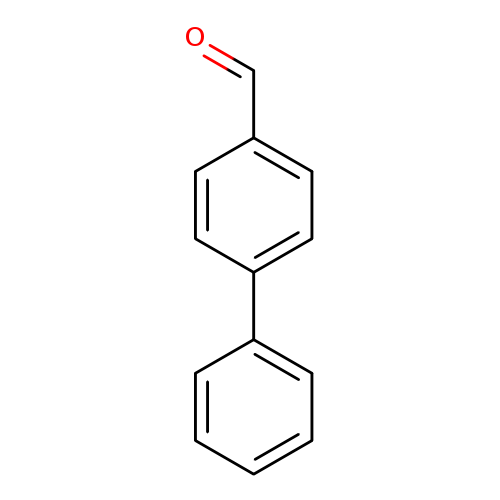
| Name(s) | 4-phenylbenzaldehyde |
|---|---|
| Scientific name(s) | 4-biphenylcarboxaldehyde; 4-biphenylaldehyde; p-phenylbenzaldehyde; biphenyl-4-carboxaldehyde; [1,1'-biphenyl]-4-carbaldehyde; 4-formylbiphenyl |
| Formula | C13H10O |
| Molecular mass | 182.22 |
| IUPAC name | 4-phenylbenzaldehyde |
| INCHI | InChI=1S/C13H10O/c14-10-11-6-8-13(9-7-11)12-4-2-1-3-5-12/h1-10H |
| SMILE | O=CC1=CC=C(C=C1)C1=CC=CC=C1 |
| CAS ID | 3218-36-8 |
| PubChem ID | 76689 |
| DrugBank ID | Not available |
| CHEBI ID | Not available |
| Description | 4-phenylbenzaldehyde belongs to biphenyls and derivatives class of compounds. Those are organic compounds containing to benzene rings linked together by a C-C bond. 4-phenylbenzaldehyde is practically insoluble (in water) and an extremely weak basic (essentially neutral) compound (based on its pKa). 4-phenylbenzaldehyde can be found in ginger, which makes 4-phenylbenzaldehyde a potential biomarker for the consumption of this food product. |
|---|